What could be done
What could be done
The proposals collected so far. Each says what it answers and which goals it serves.
Deciding together
1. Change how we vote, step by step. A vote today reduces everything a person wants to one choice among a few parties, and what is lost cannot be recovered. Each person has a choice, but the community as a whole does not. Voting could change in steps:
- first, vote on values, and let parties form around them;
- then, vote on several wants, with clear consequences for each choice;
- then, compare wants against each other;
- finally, include how wants depend on other people.
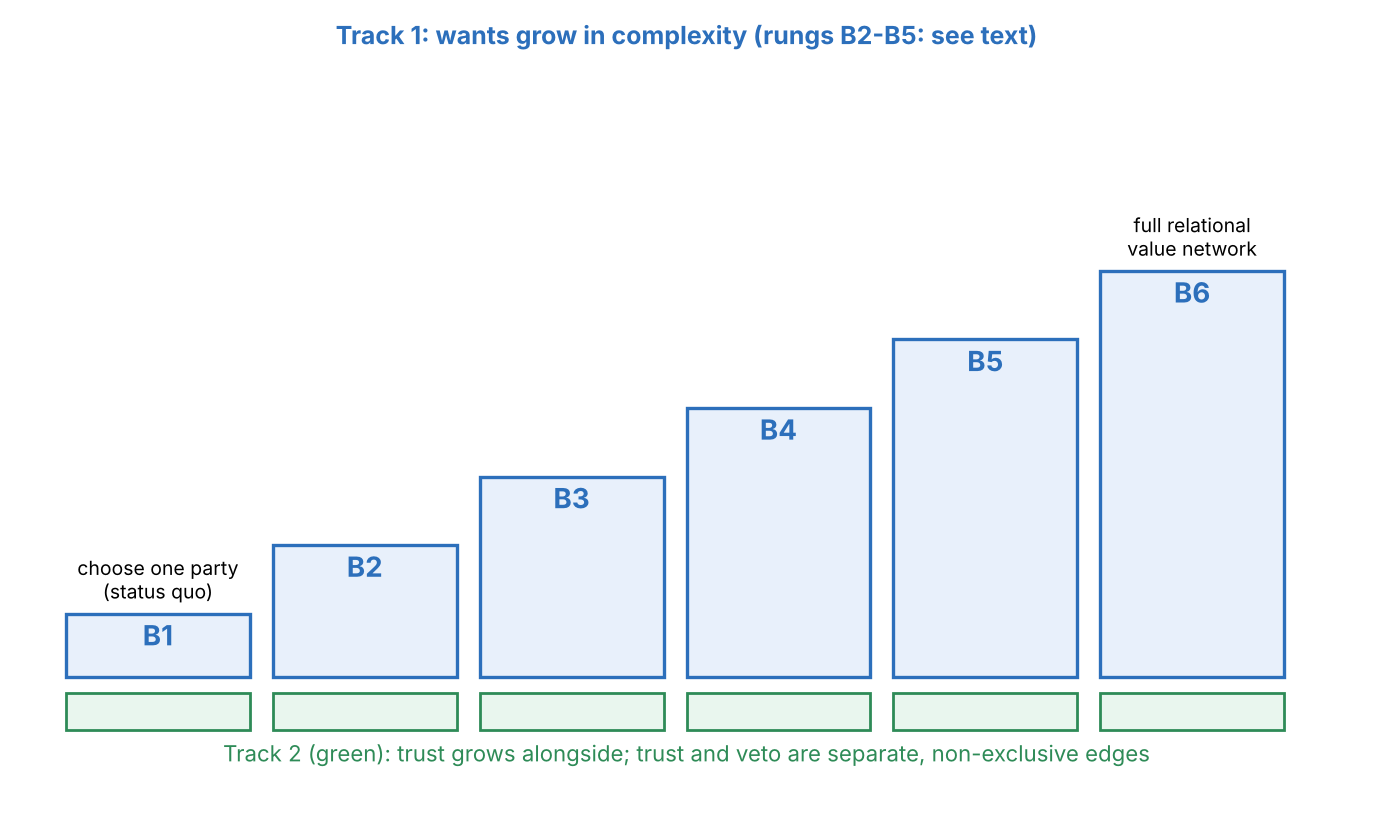
Along the way, votes could carry different weight per topic, for example by age where a topic concerns one generation more. Voting could also become more direct gradually: including children, allowing abstention, and delegating a vote to someone trusted on a topic.
This serves finding out what is wanted and whom we trust to carry it out, and changing the current system into a better one.
2. Make voting resilient to coercion and bribery. Secret voting removes consequence, gives influence without power, and does not protect against coercion. Money and lobbying still reach into votes. Three things work together here:
- Votes can be open and frequent, held at different times, so each single vote carries less power and there is less reason to coerce or bribe anyone.
- An open decoy vote next to a secret channel, where only the last secret vote counts, lets people give in to coercion in public and still vote freely. The difference between the two shows where coercion happens.
- Above all, voters themselves need to become resilient to bribery. That is a task of education, not of money.
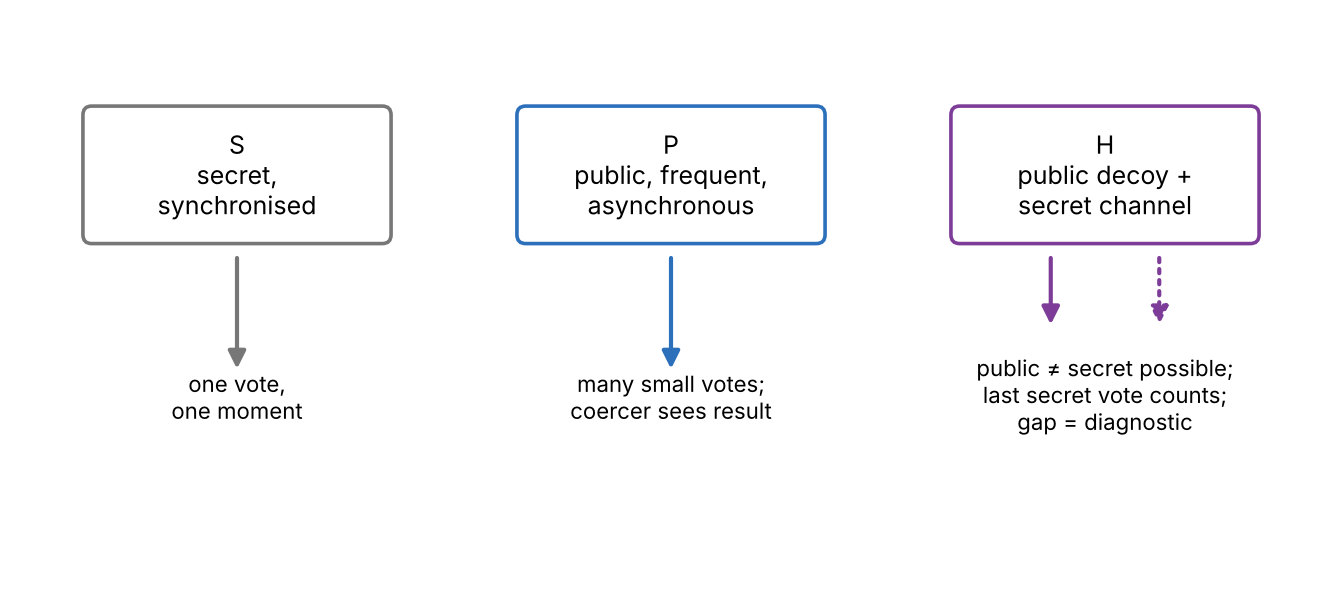
This serves finding out what is really wanted, and building resilience against manipulation.
3. Let consequence and cost resolve deadlocks. Choices without consequence carry little information, and conflicts are often made exclusive by the way we decide. Where a decision is stuck, making consequences and costs visible is what lets it move.
This serves finding out what is wanted.
Money and work
4. Split the jobs of voting and money, as a step. Voting and money each try to do two jobs at once: finding out what is wanted, and managing trust and resources. As a step, the jobs could be split:
- Purchases no longer have to show what is wanted. Money is still used to manage motivation, trust and resources, and buying and paying stay as they are, because that distributed system is hard to change.
- After a payment, the actions the money pays for follow what was found out by voting, not only what the receiver decides.
- Voting decides who gets how much money, for example income and wages, and money carries it out.
This answers pooling, the belief that money stores value, and the mixing of the two jobs. It serves finding out what is wanted, managing trust, and changing the system.
5. Protect minorities through resilience and decentralisation. If voting decides who gets how much money, a majority could decide about the resources of a minority. A resilient, decentralised society, in which the flow of money is spread over many people, is harder to turn against a few.
This serves managing trust.
6. In the end, one system. Finding out what is wanted, managing trust and carrying out what is wanted should eventually be one system, not two that pull against each other.
This serves all three goals at once.
7. Let jobs blend into one another. Treating many different actions as one fixed job creates gaps between jobs and leaves people unemployed who could do part of what is needed. If jobs could blend, people could move between actions.
This serves using everyone's potential.
Care and needs
8. Communicate needs ahead, and plan with backups. Supply and demand only reacts when a shortage is felt, and in care that scarcity costs lives. Needs that can be known in advance should be communicated in advance. There should also be backups, people trained but not working, and ways to bring them back or improve conditions so they return.
This serves reducing problems at their causes.
Hurt and resilience
9. Reduce how many wants to hurt arise, by changing their circumstances. A punitive system acts only after harm. In a society where people keep being born and some come to want to hurt, that leaves a steady rate of harm. Being hurt, including being punished, creates new wants to hurt. Harm only falls for good when fewer such wants arise. For many harmful acts we know the economic and social circumstances in which they arise, and changing those circumstances is how fewer wants to hurt can arise.
This serves reducing hurt and reducing problems at their causes.
10. Separate protection and trust from punishment. Punishment hurts those who care about the punished person too. Mixing trust with punishment makes innocent people fear wrongful punishment, and that fear can be used against them. Whether we trust someone is a different question from whether they are punished. Protecting others from someone does not require hurting that person.
This serves reducing hurt and managing trust.
11. Help victims and offenders, in separate spaces. Both those who were hurt and those who hurt need help: spaces for healing, for safe everyday living, and for people with strong tendencies to hurt. This answers the cycle in which being hurt creates new wants to hurt, and the hurt that punishment spreads.
This serves reducing hurt and reducing problems at their causes.
12. Teach along a gradient: from talking to tested temptation. Resilience needs experience; talking alone is often not enough. Teaching can move from talking, to showing, to experiencing, to being tested under real temptation. What is taught:
- how to stop oneself from hurting others, or that harm can't be hidden;
- how manipulation works, instead of banning it;
- when to align with others and when to resist.
Teaching is also what makes deterrence possible at all, because everyone has to learn about consequences before they could do harm.
This serves building resilience and reducing hurt.
Getting there
13. Change gradually. People are bad at sudden change, and transforming a running system is different from designing one from scratch. We don't start from a blank page: change can happen step by step, crossing each bridge when we come to it. The steps for changing how we vote (1) and the split between voting and money (4) are examples of such steps.
This serves changing the current system into a better one.