Goals · 2
Acting on what is wanted
Goal: act on what is wanted, thought through completely.
Value can't be stored
Money is believed to store value. Value cannot be stored. Value, how much an action is wanted, exists only while it is wanted. Believing it can be stored makes "now or later" look exclusive, and hides everything that is not done.
Seen this way, insurance is not stored value either. It is an action: caring for those struck by risk, injury or harm, and keeping up the means to do so.
Paying work, not persons
Pay is tied to work done, not to persons. We don't trust people to work on their own, so the work is valued, not the person or their development.
A job is usually the only income. So the employer alone has to cover everything the employee and their family need, and ends jobs when it believes it can't afford them, now or later.
In a crisis, saving stops money reaching employers. Fewer wages are paid, so people save more, in a loop. The society does less, while its ability and its will stay the same. Only the communication, through money, is broken.
Illustration: shows what follows from these assumptions; not evidence.
A small model: 100 persons, 10 employers, a fixed amount of money. Everyone is able and willing to work in every run except the last one, which is a control. With today's rules, a belief shock (people expecting bad times) leads to a deep crisis, with unemployment peaking at more than half. When nobody holds money back, the same shock causes nothing. When part of all revenue is shared as income with everyone, the crisis also doesn't happen. A real shock, where a quarter of the people really can't work for a while, causes far less missed work than the belief shock does.
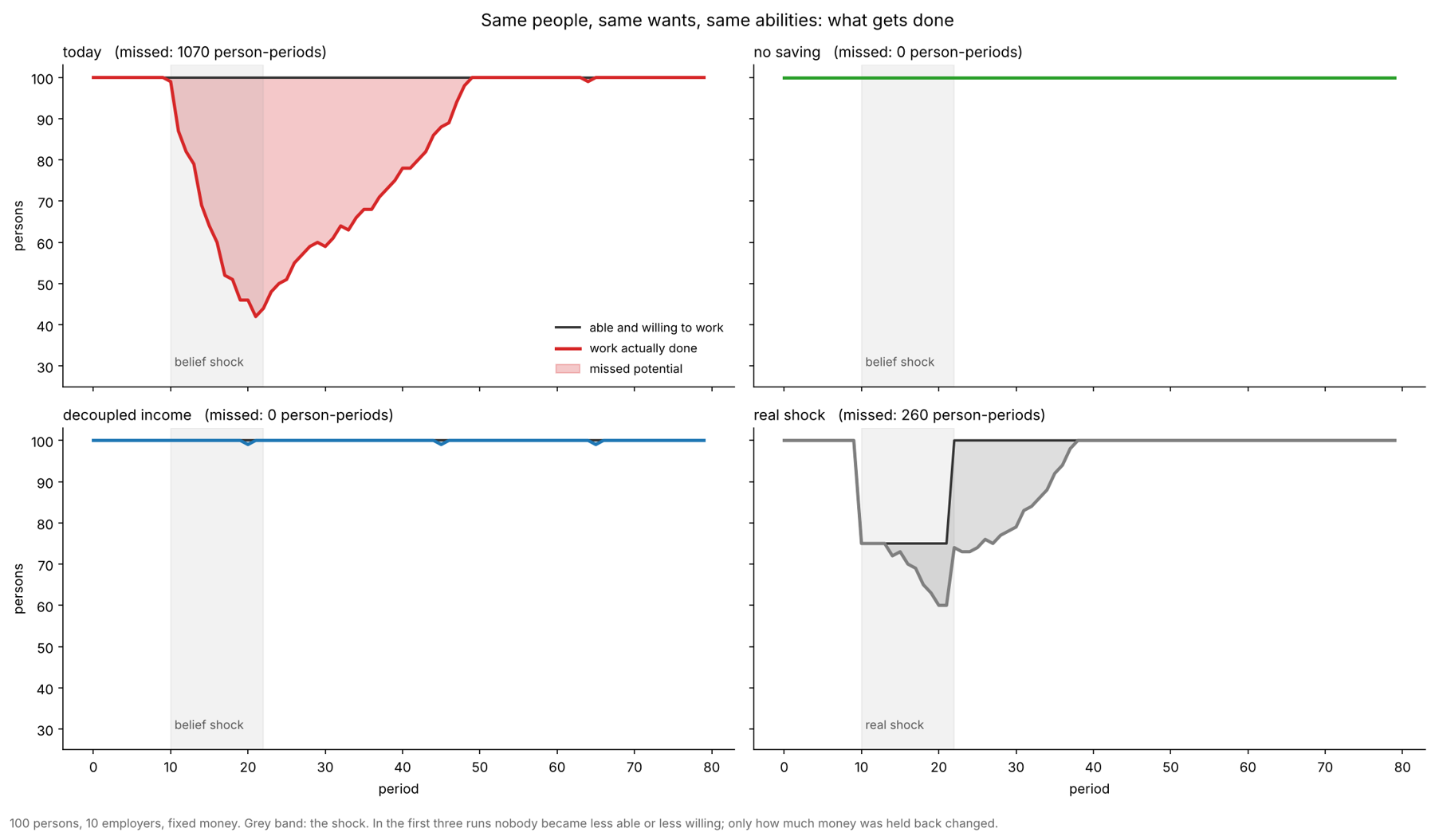
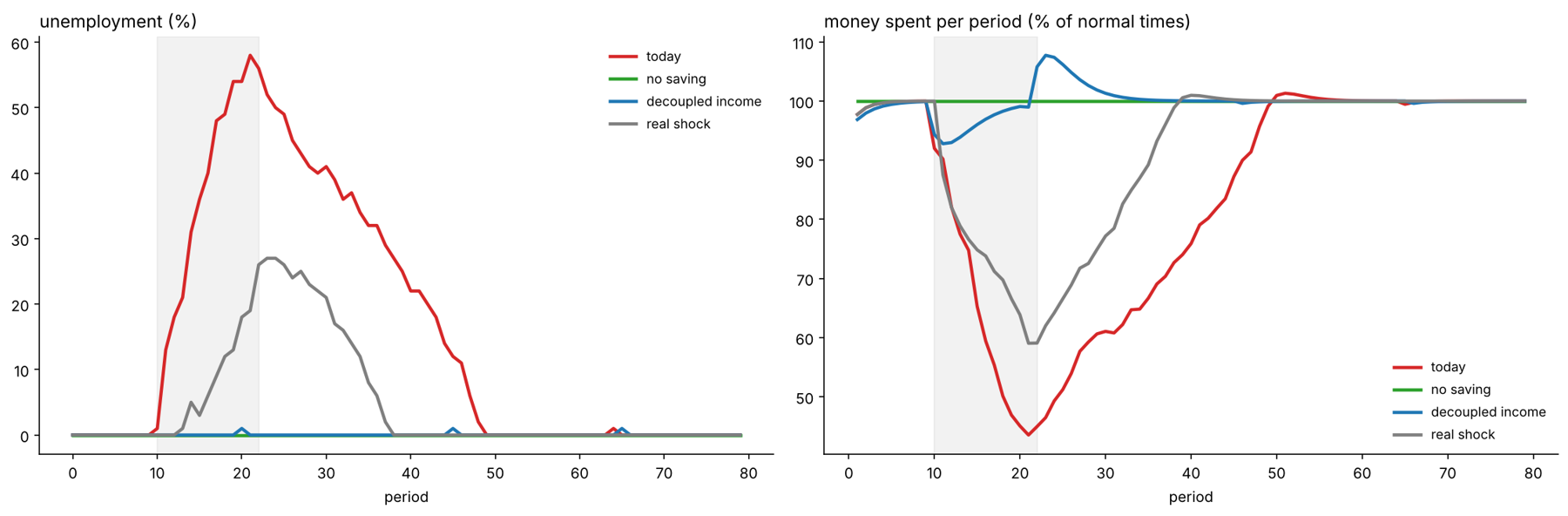
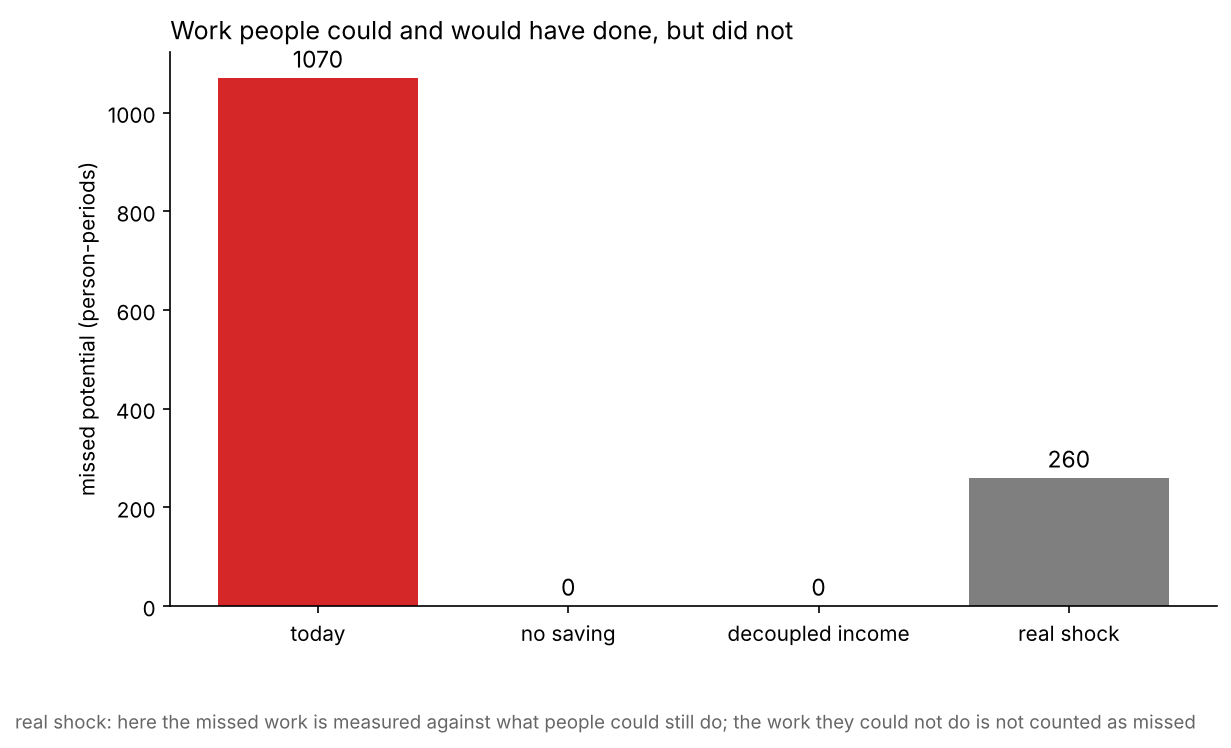
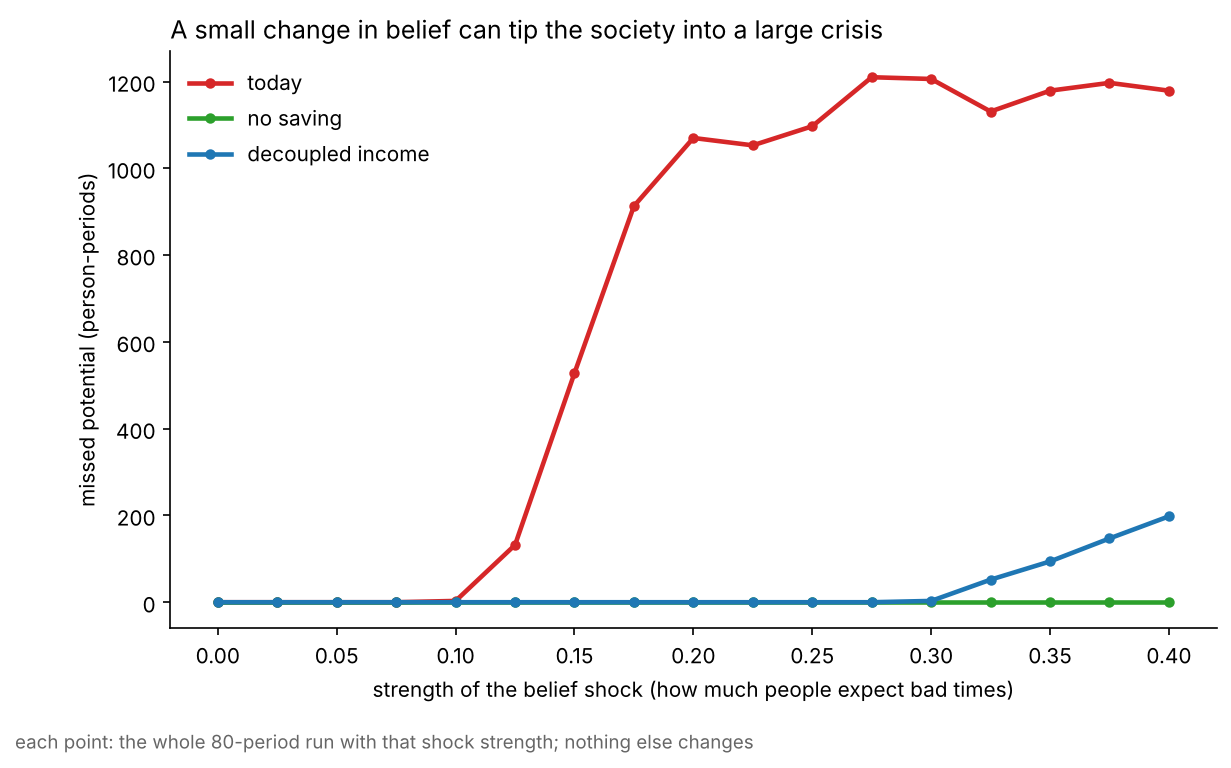
The model's settings were adjusted so that it is stable without a shock.
Because pay is tied to work, a changing sector gets rescued with unbound money, undoing the change. If people stopped buying from a sector, the state or others would likely use stored or unbound money, for example from taxes, to rescue its businesses and jobs. As long as income is tied to a job, such a rescue looks necessary to keep people paid, and it undoes the change the people made.
Keeping alive what stands in the way
What stands in the way of change is kept alive by the same money that would be needed to replace it. Everything that exists is paid for by the flows that a change would have to redirect.
Using everyone's potential
Acting on what is wanted includes using what people are able and willing to do. Missed potential is what persons are able and willing to do, but what is not done.
Structural unemployment: we don't know what is needed, because we don't know what we want.
Frictional unemployment: many different actions are treated as one job. A job is a collection of actions. Treated as one fixed thing, it leaves gaps between jobs, and people out of work who could do part of what is needed.
Missed potential includes people who don't fit standard jobs, work not seen as work, and unpaid work. Very likely every person is valued and can do something valued; the money system can't see it finely enough to notice it and pass it on. Emotional support and raising children are work, done without pay.
Seen from a society's wants and possible actions, "unemployment" may lose its meaning. It is a word for single people without a fixed job, not for what a society wants and can do.