Goals · 1b
Finding out what we want: money as a signal
Goal: find out what each person and each group wants, and respect it.
Value and price
Value is a comparison between wants. Something is better than something else if it is wanted more (see Foundations). Value names that comparison. Like every comparison of wants, it belongs to someone, it can be uncertain, contradictory and changing, and it has no amount. A price is something else: the amount of money for which something changes hands.
Money is an item that makes exchange easier; it is not a measure of value. A market is a strategy working on a society's value system: one way of trying to get what is wanted. A financial system should be a way for a society to communicate and explore its value system. Seen this way, money has the same job as the vote: finding out what a society wants.
Three more words are needed. An action is something done in the world; products come from actions, and releasing emissions is an action too, so it can be measured. An actor is anyone who receives money and decides what to do with it: a producer, a shop, the state. Actors are members of society too. Pooling means that money from many sources mixes: after a sale it can be used for anything, within laws that money, influence and lobbying can change.
What money can say
Money pays for past products, assuming the same is wanted again. It pays for products, not for the actions behind them, so it cannot say what should be done next. Every purchase pays a part of every future action of the company that receives it.
Supply and demand cannot discover a want nobody offers yet. Only those with money can make new offers.
Illustration: shows what follows from these assumptions; not evidence.
The model uses a small society: 24 persons, ten products (two of them labelled eco and fair) and five values: workers treated well, the environment protected, producers earning, things being affordable, and animals treated well. First one want and one value, for each person and for the society:
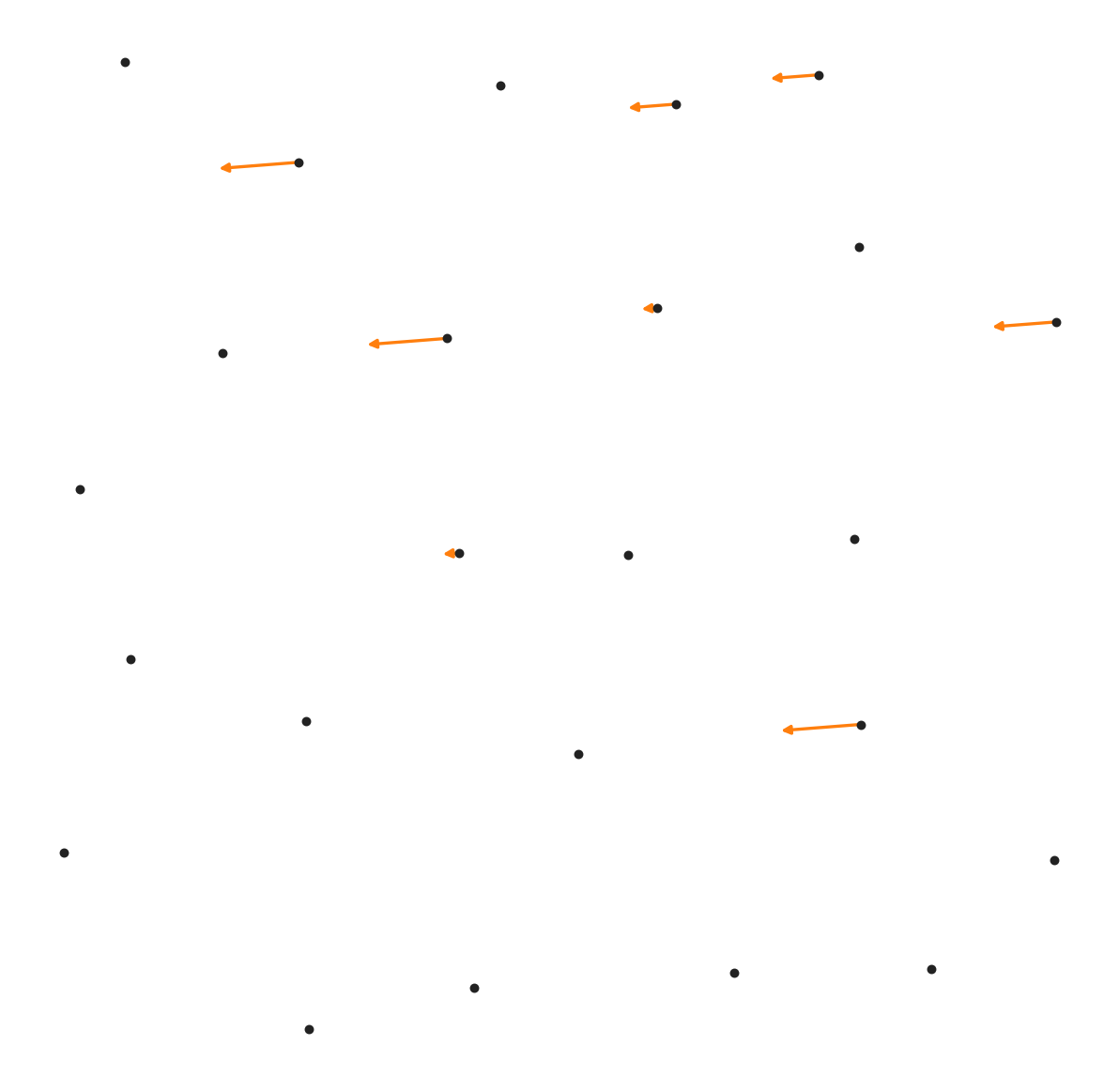
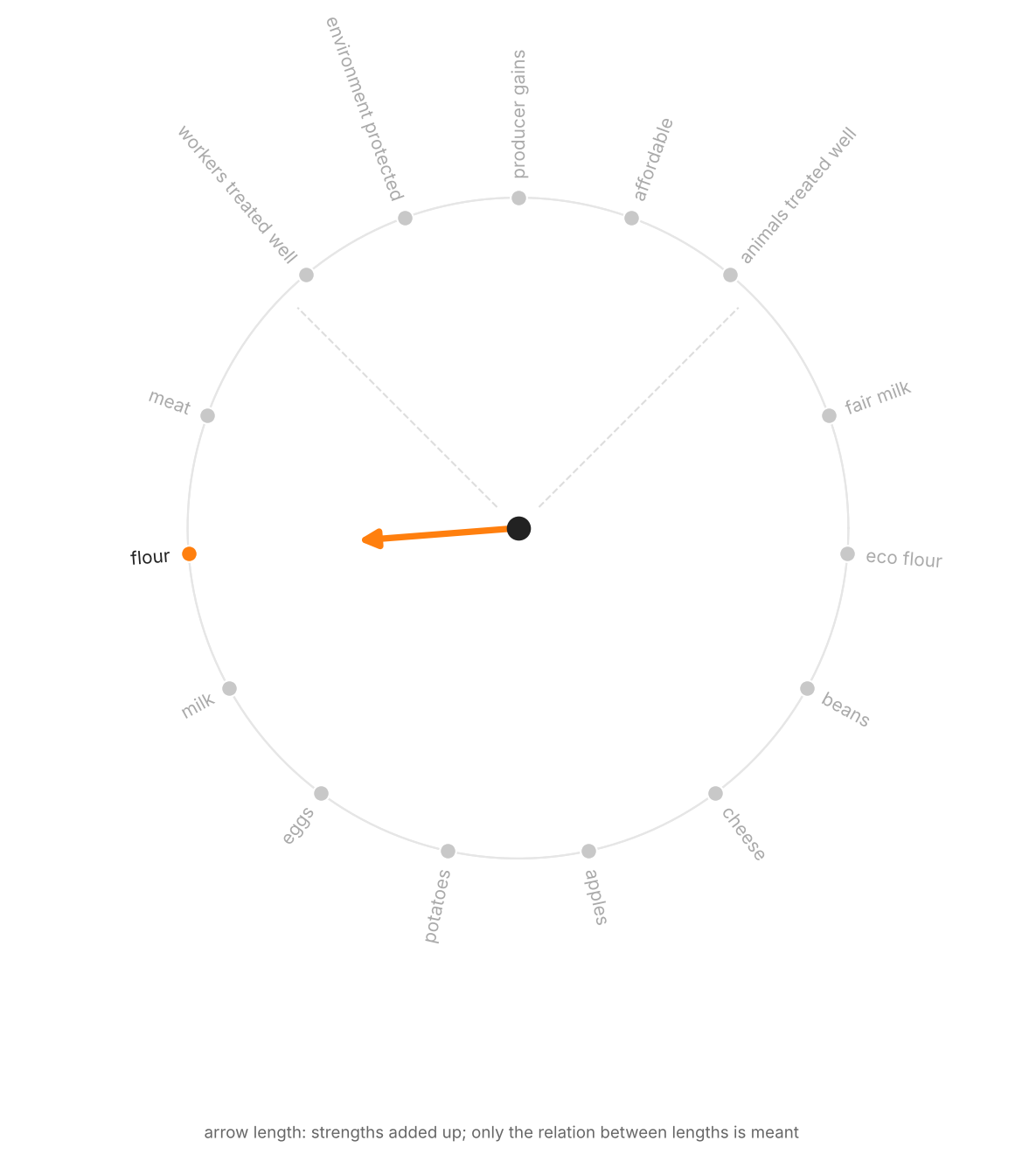

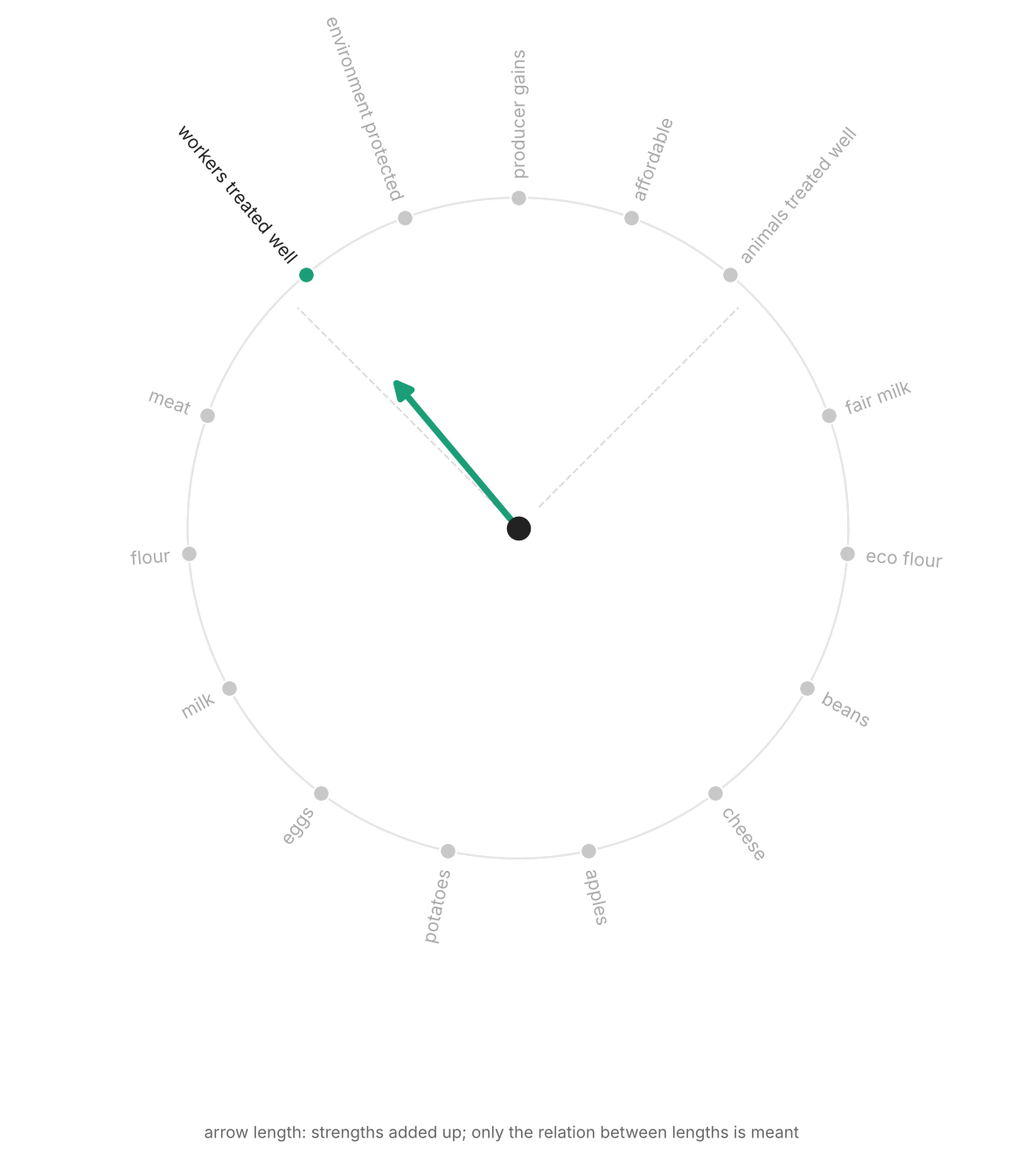
Then all values and products together. The values sit in the upper quarter, the products below:

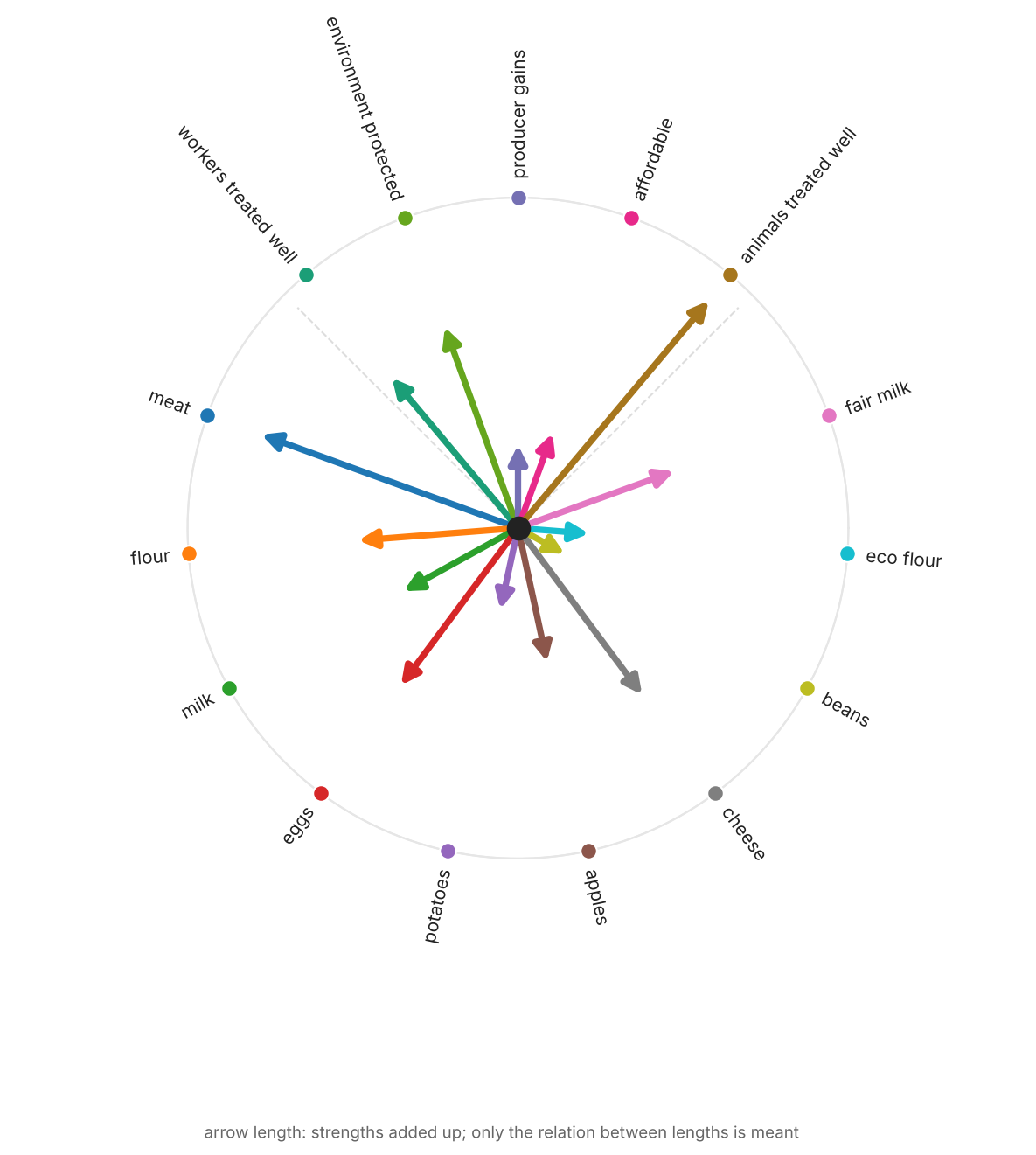
From the values follow the actions people want done:
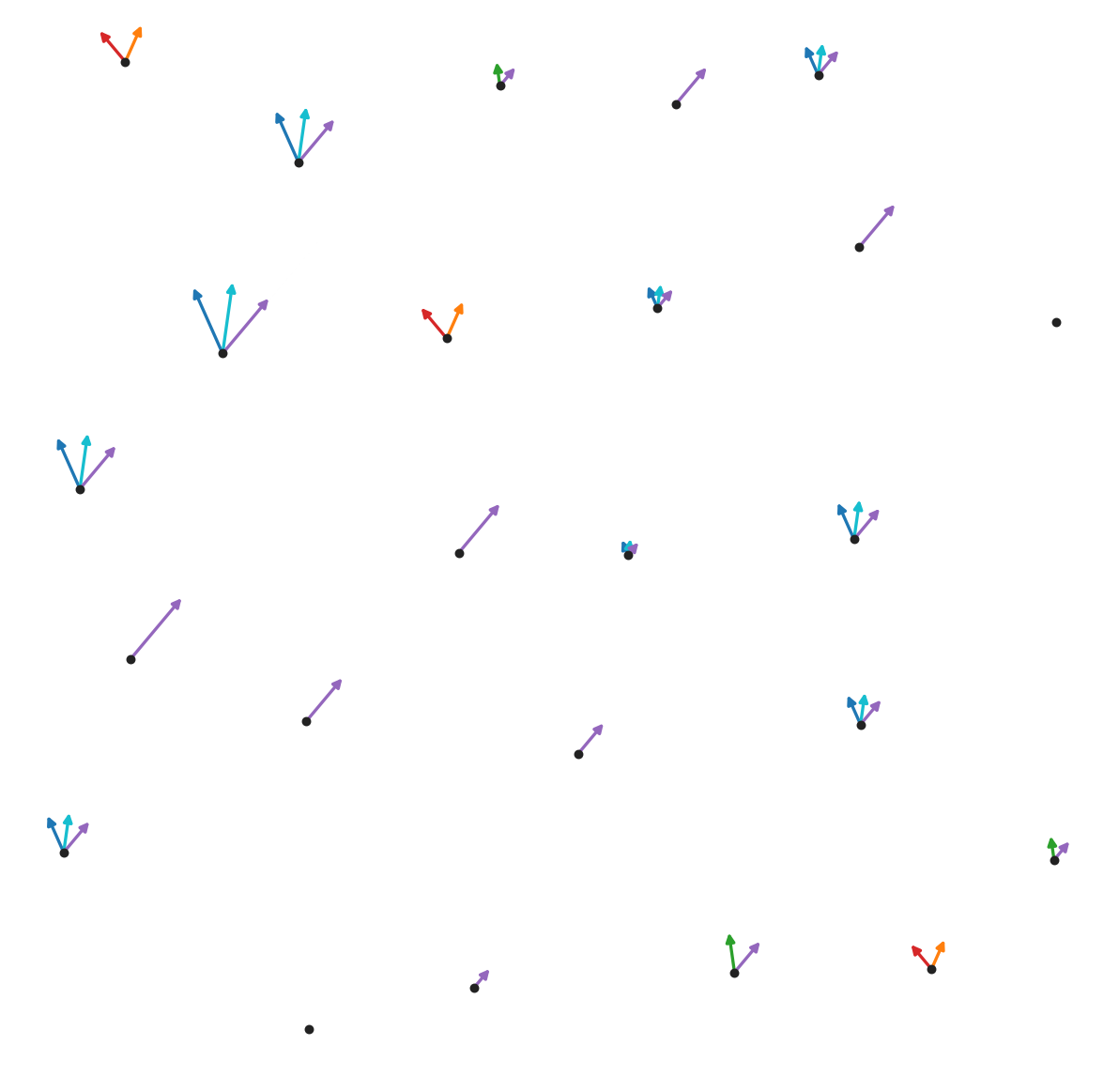
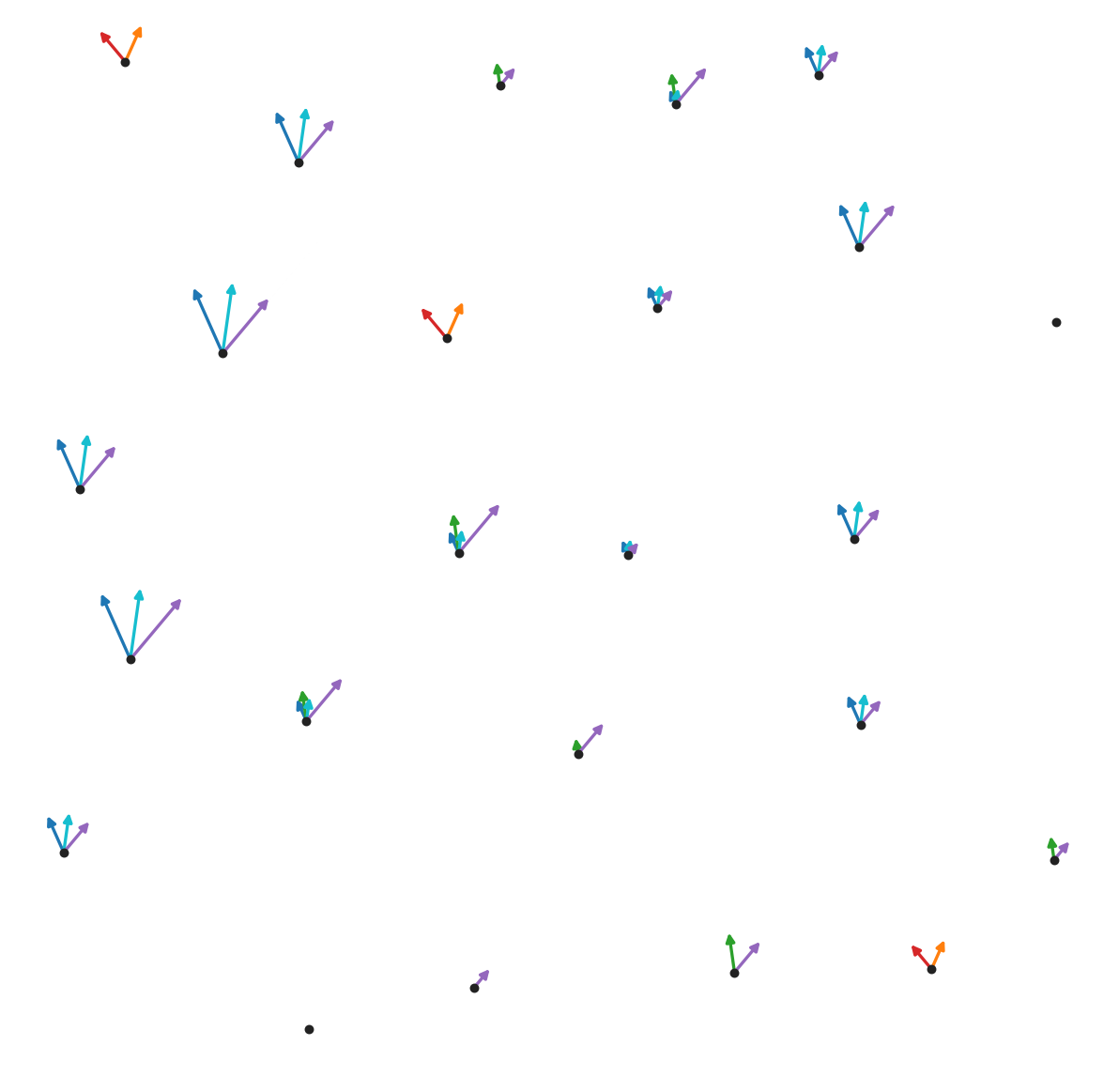
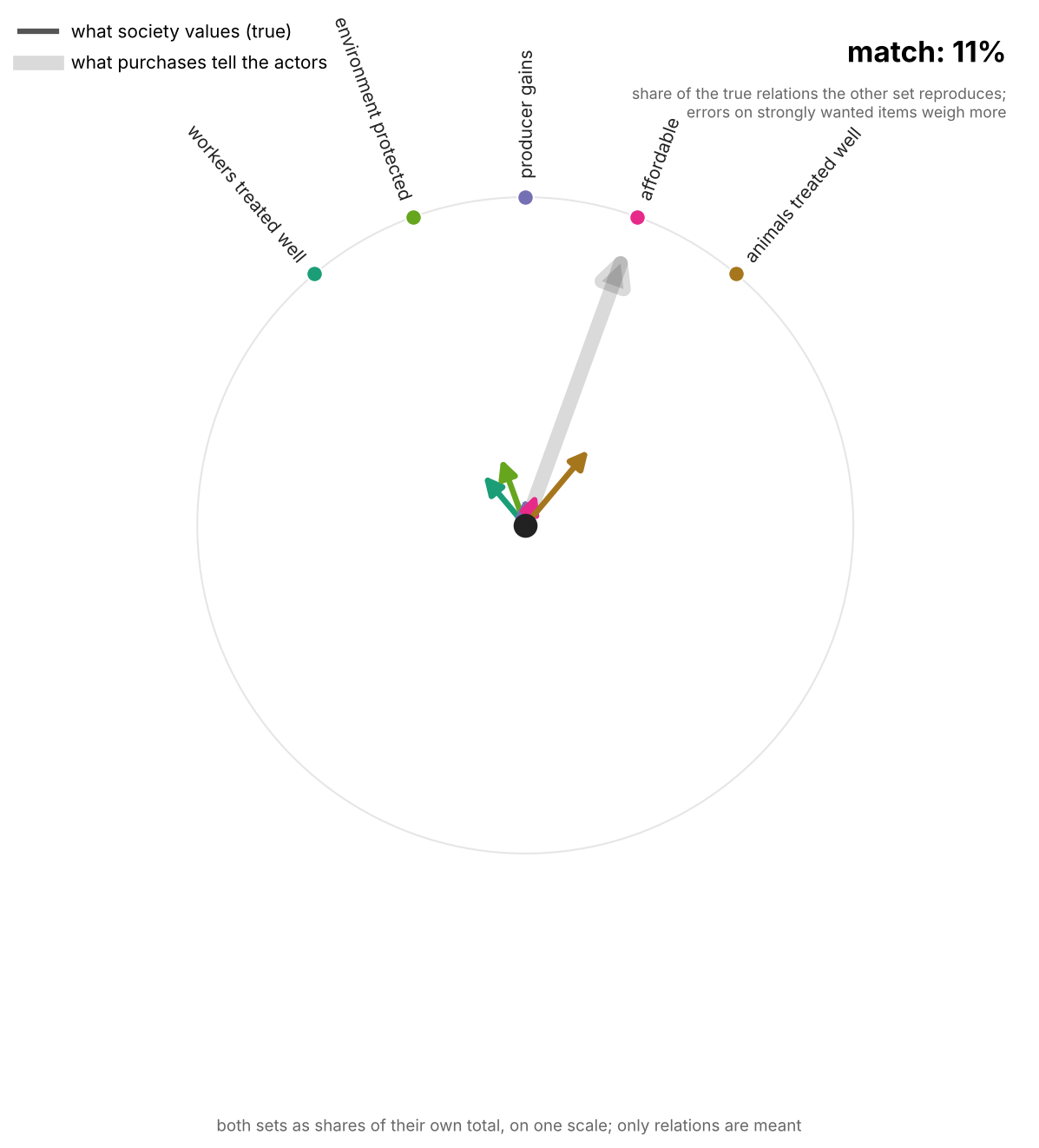
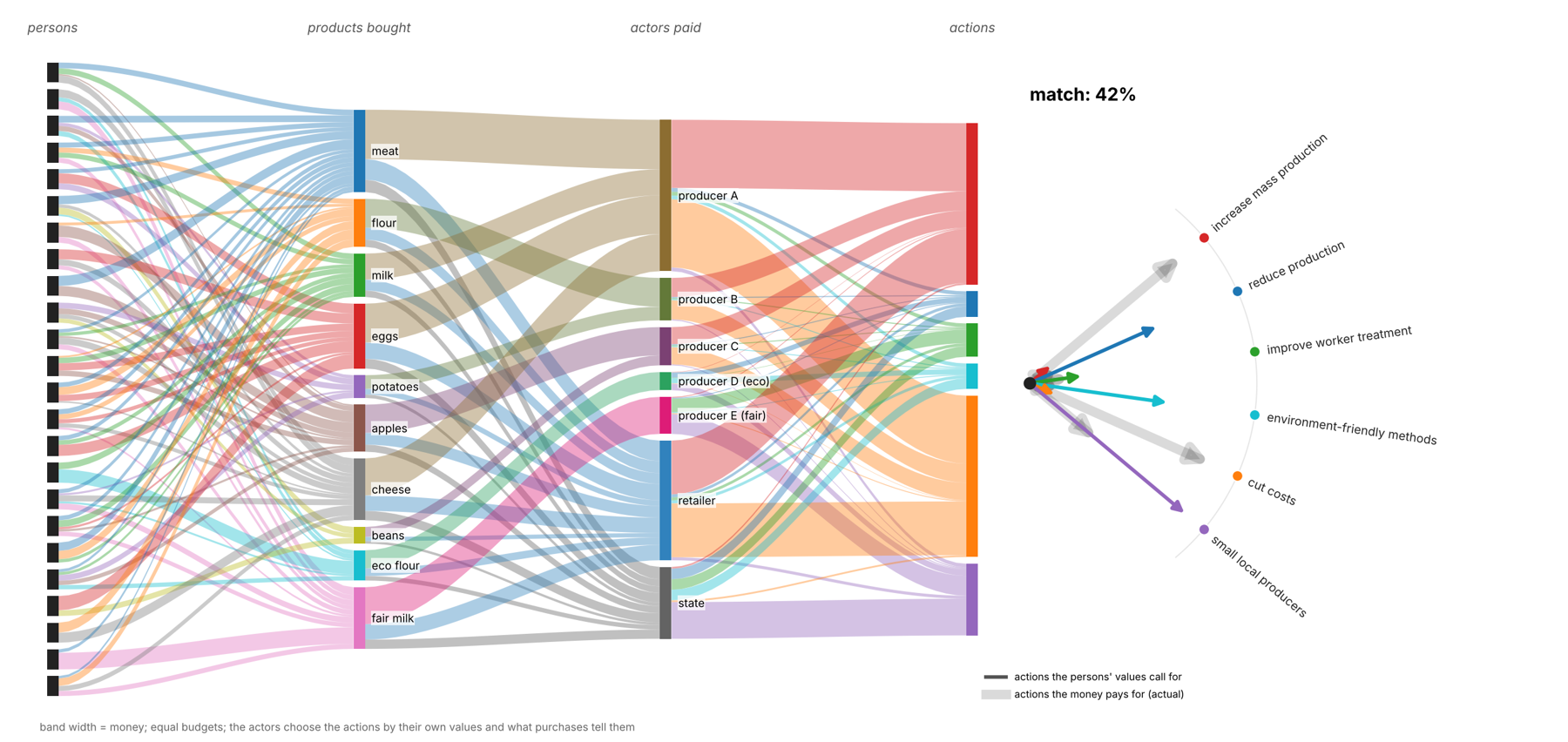
Producers don't see values. They see purchases. Comparing what the society values with what its purchases tell the producers, only a small part comes through:
Where the money goes
Actors decide by their own beliefs about a chaotic market, not by society's values, and in their job may act against their own. The market they look at influences itself, so what they will do next, and what the society will do next, is not determined.
Illustration: shows what follows from these assumptions; not evidence.
In the small society, the actions that result differ widely from the ones the society's values call for:
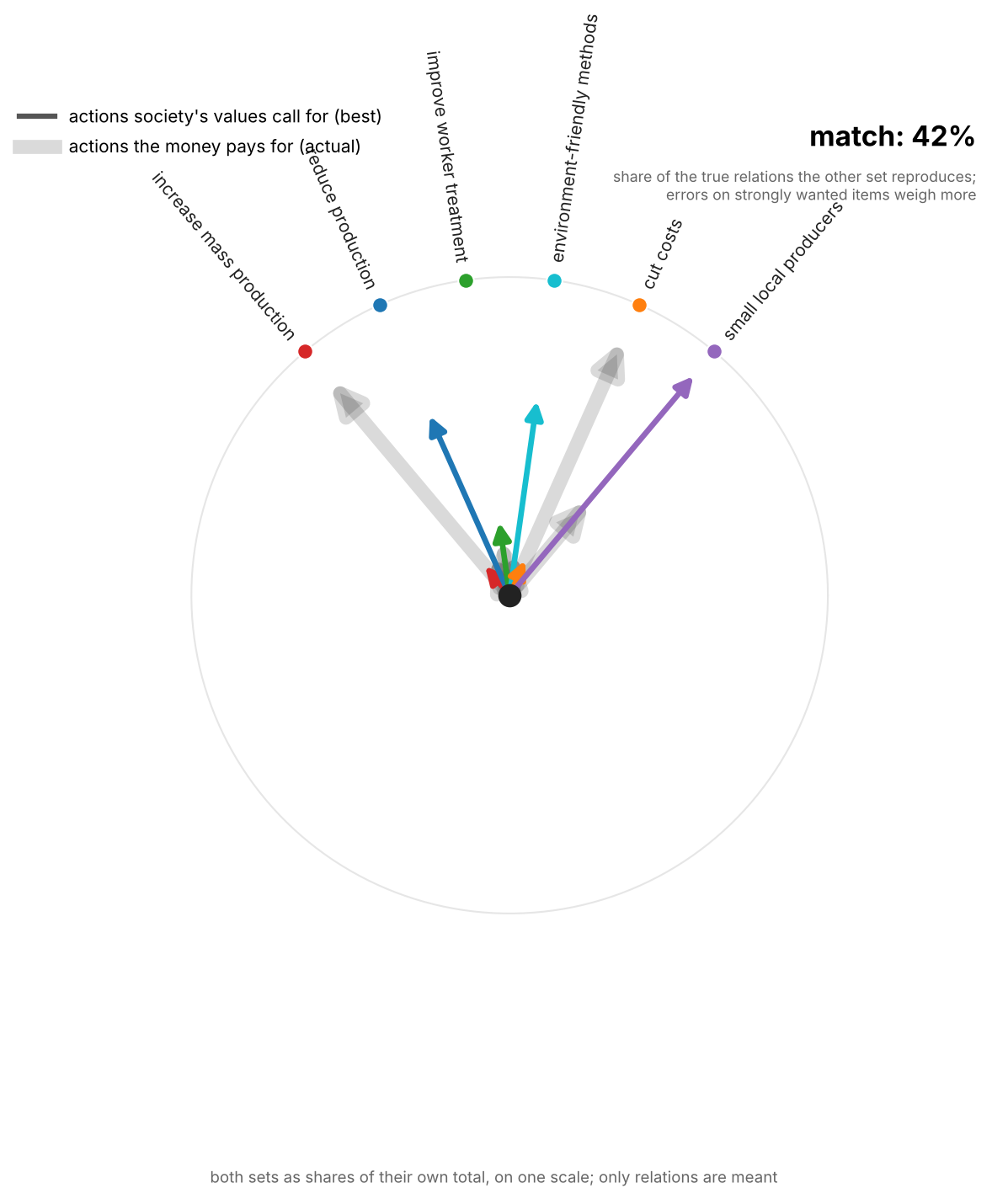
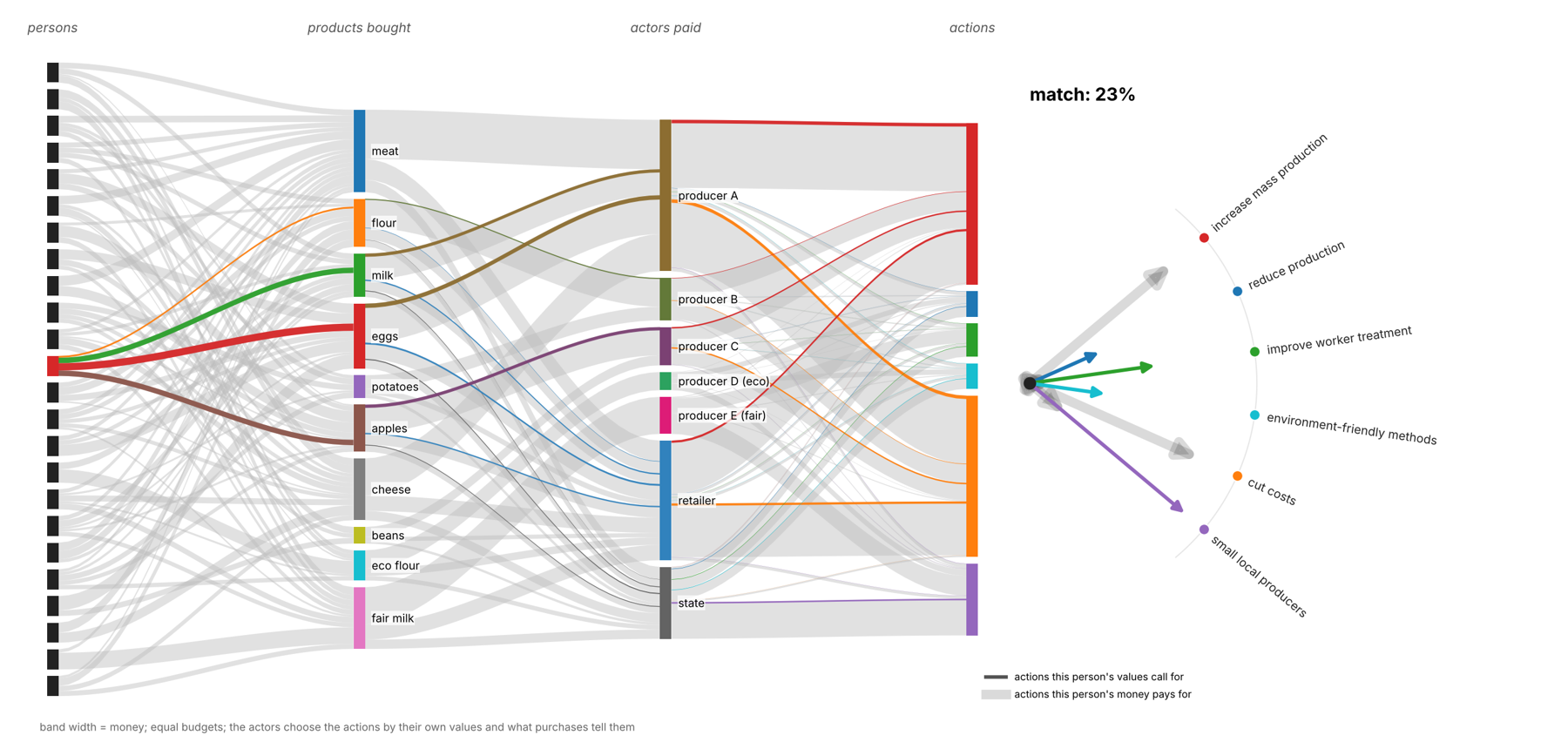
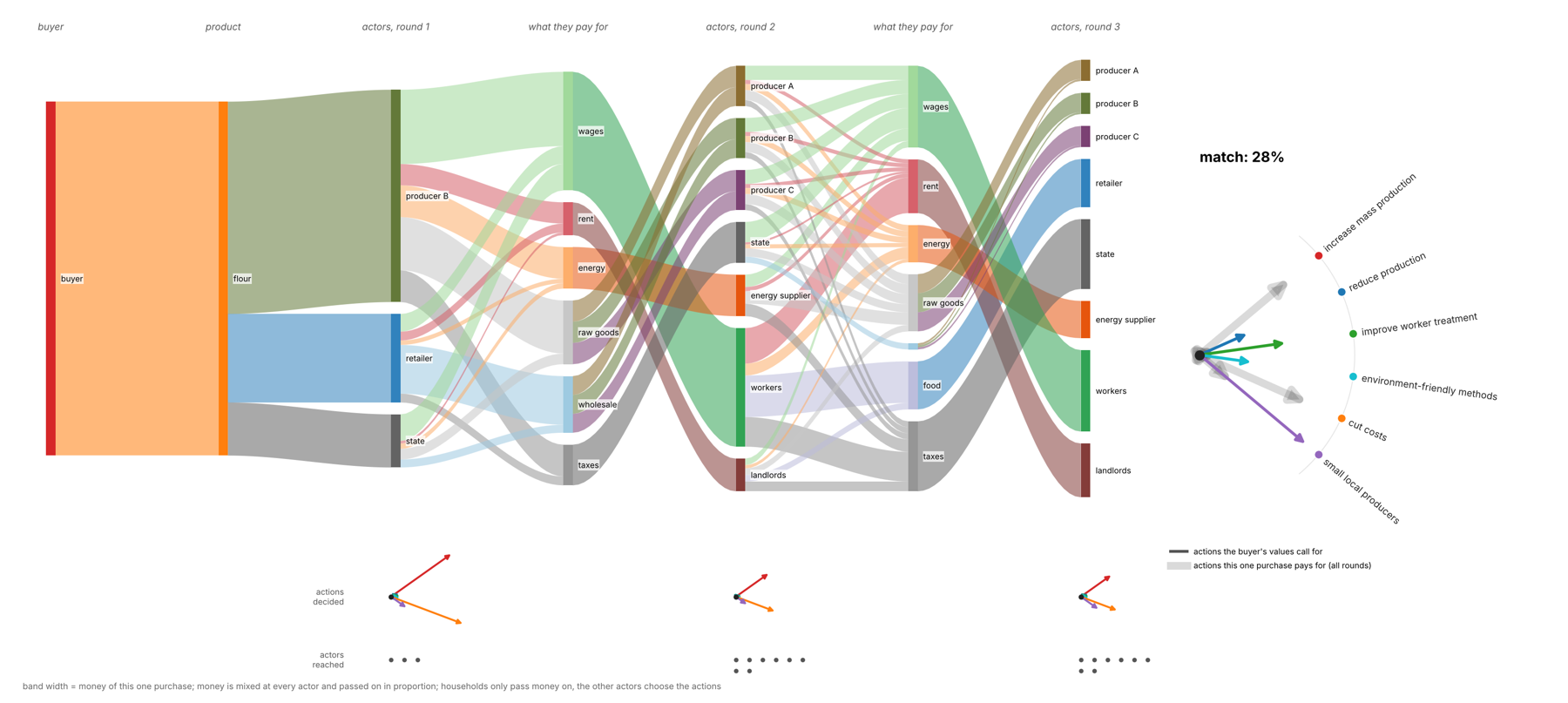
Every purchase pays many actors, who pay many others. A purchase pays a shop, which pays a producer, the state, a transport company, its staff, and they pay others. Through pooling, the intention behind a purchase blurs within a few rounds, and different products end up paying for similar actions. Buying could only steer if different products led to different actions that are known in advance, but steering is not what buying is for: we buy products because we want or need them.
Illustration: shows what follows from these assumptions; not evidence.
Following the money of the small society through products and actors to the actions it ends up paying for:
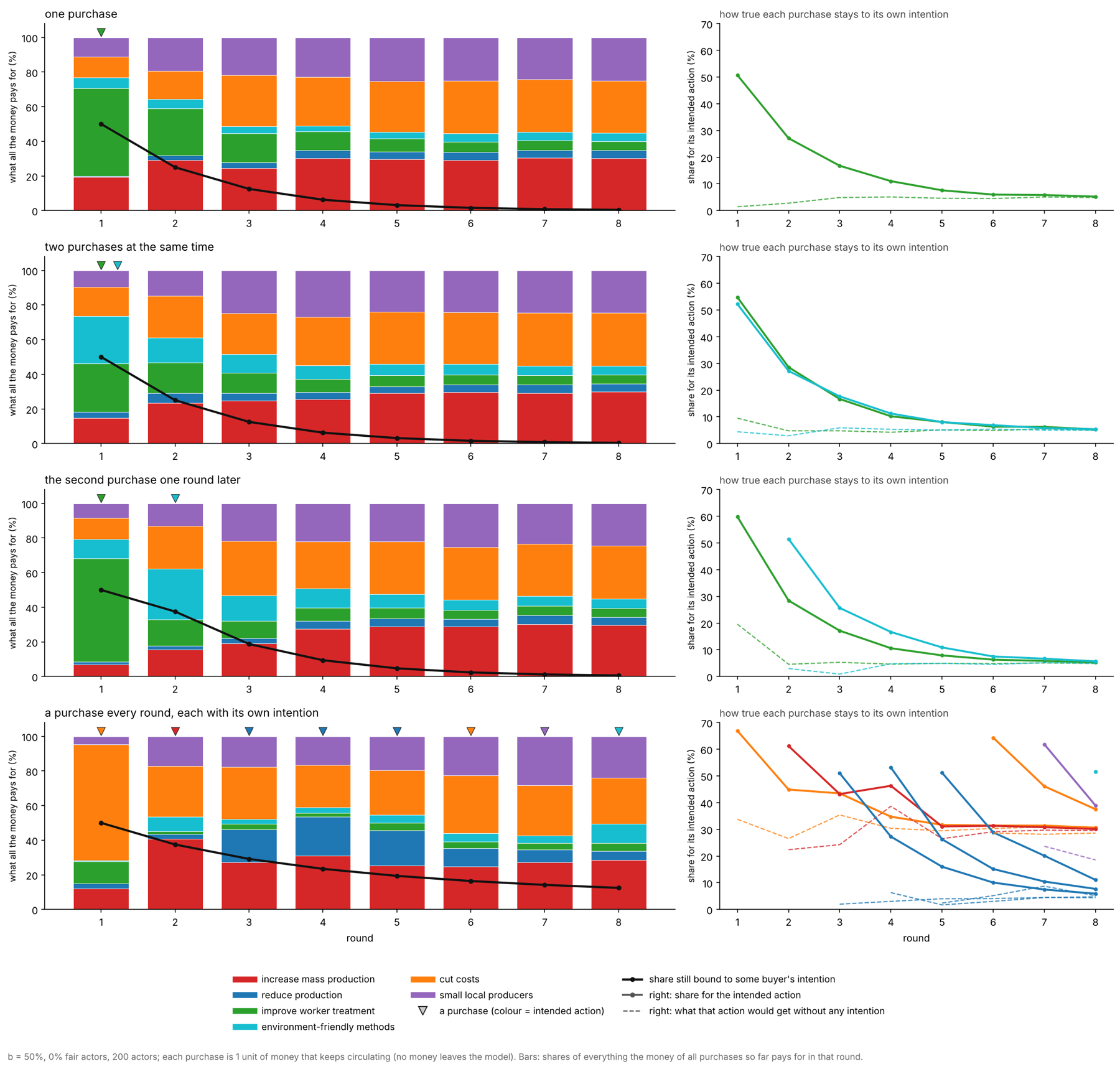
Following a single purchase over several rounds, it spreads over almost everything:
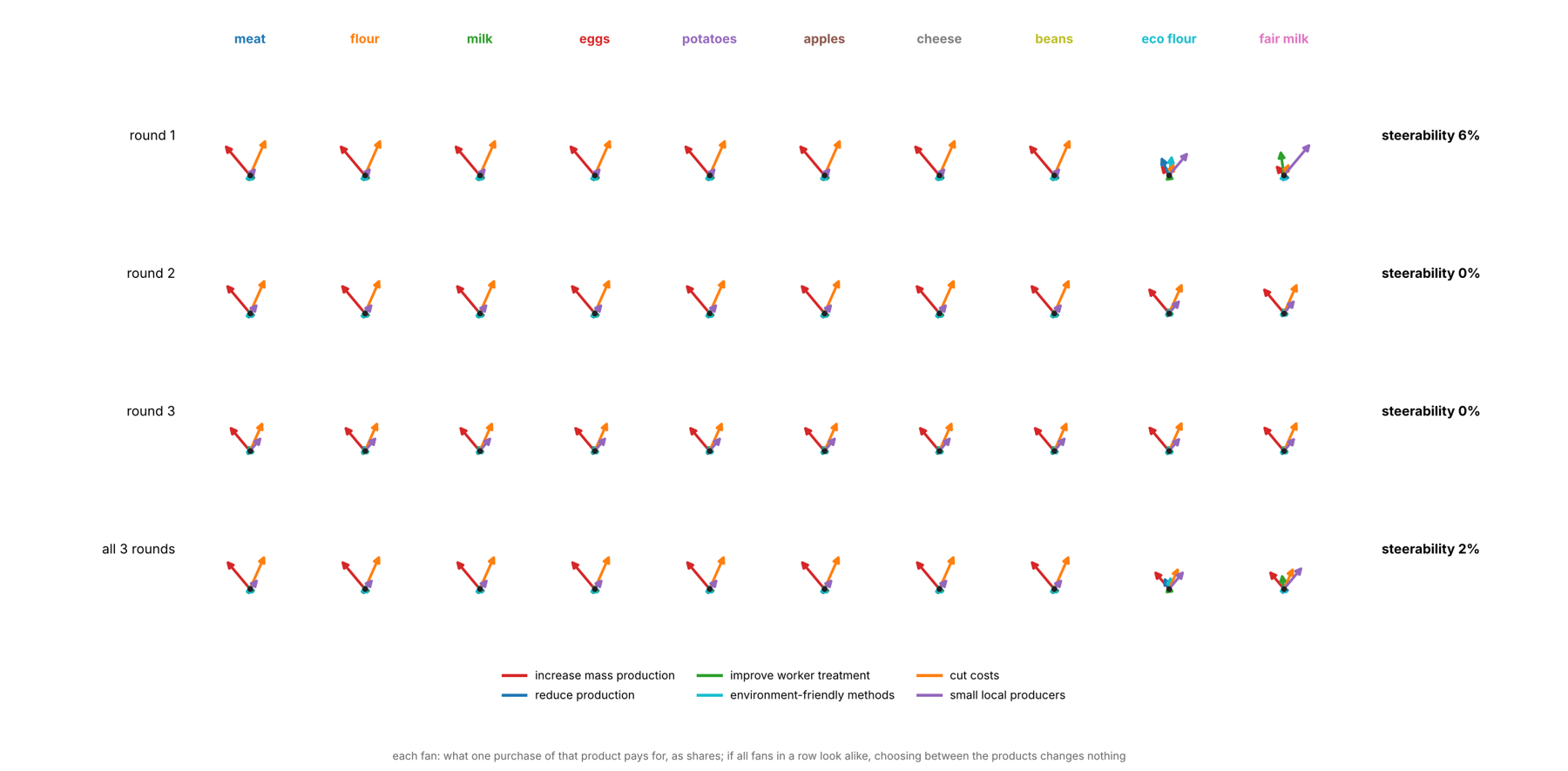
How much the choice of product still steers, and how much even the best shopping basket could steer:
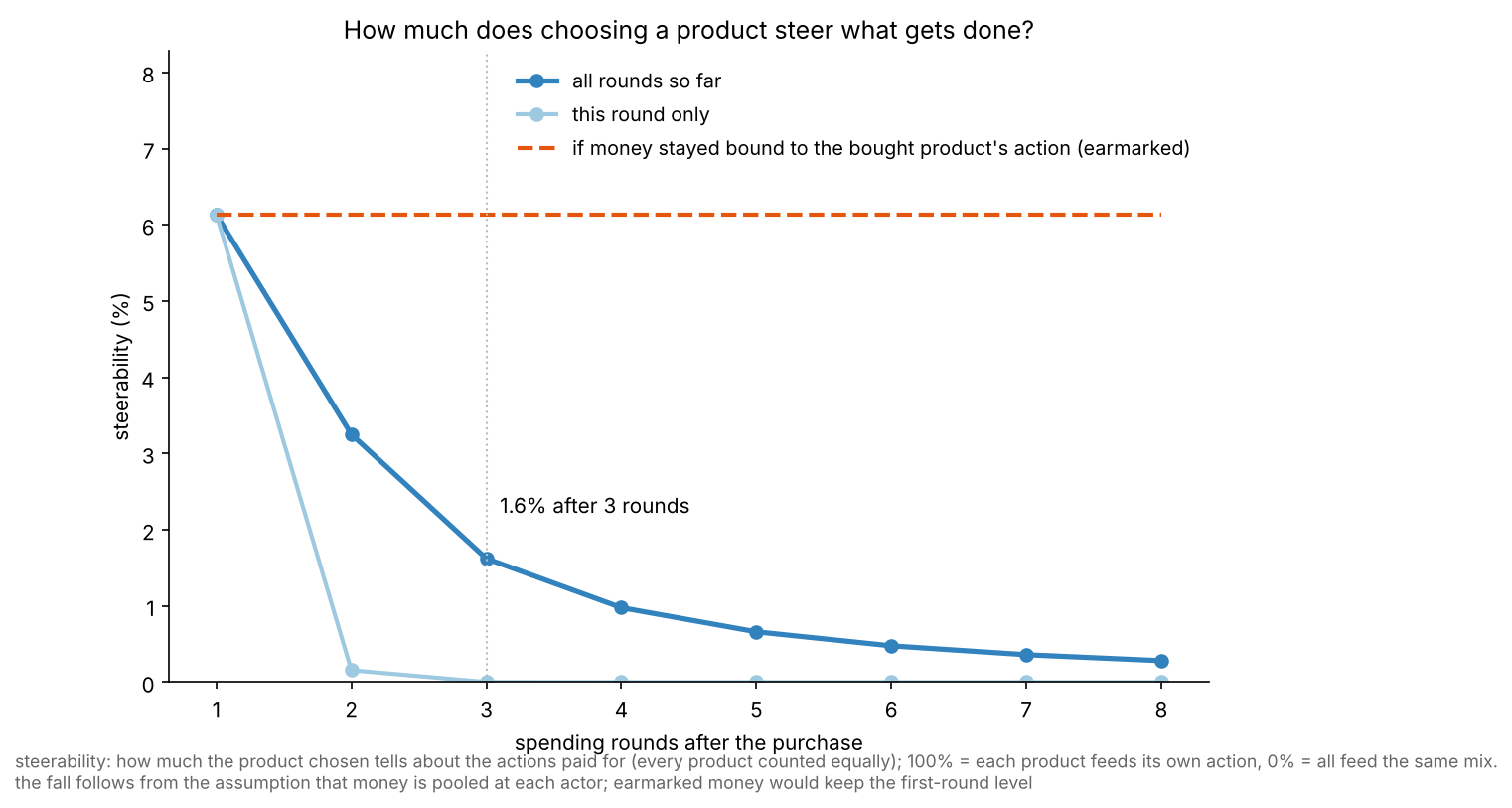
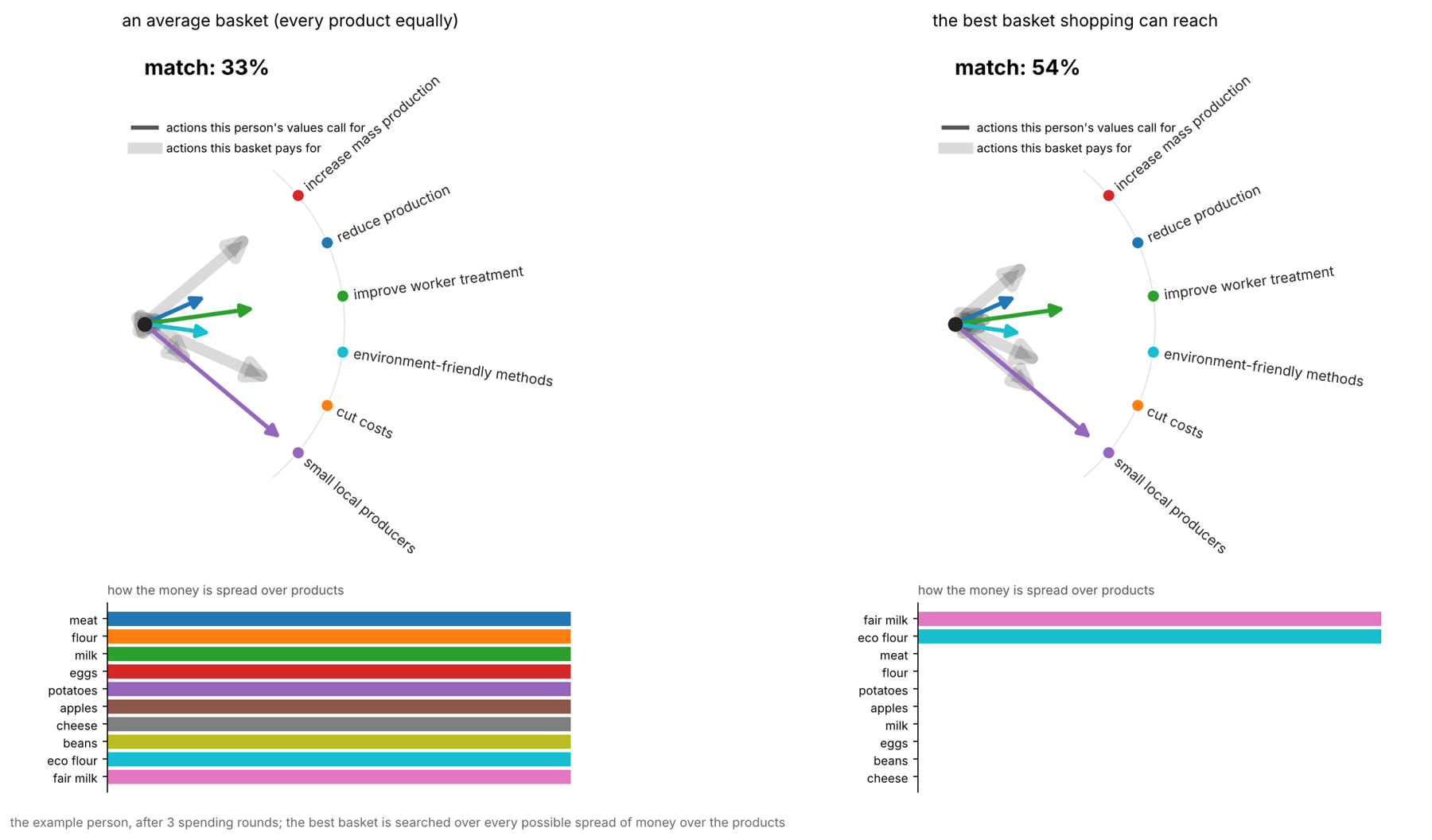
Earmarking is undone by pooling and taxes. Even when part of the money is bound to its purpose, each purchase still contributes to a whole range of actions. How large the bound part must be to keep its intention is an open question.
Illustration: shows what follows from these assumptions; not evidence.
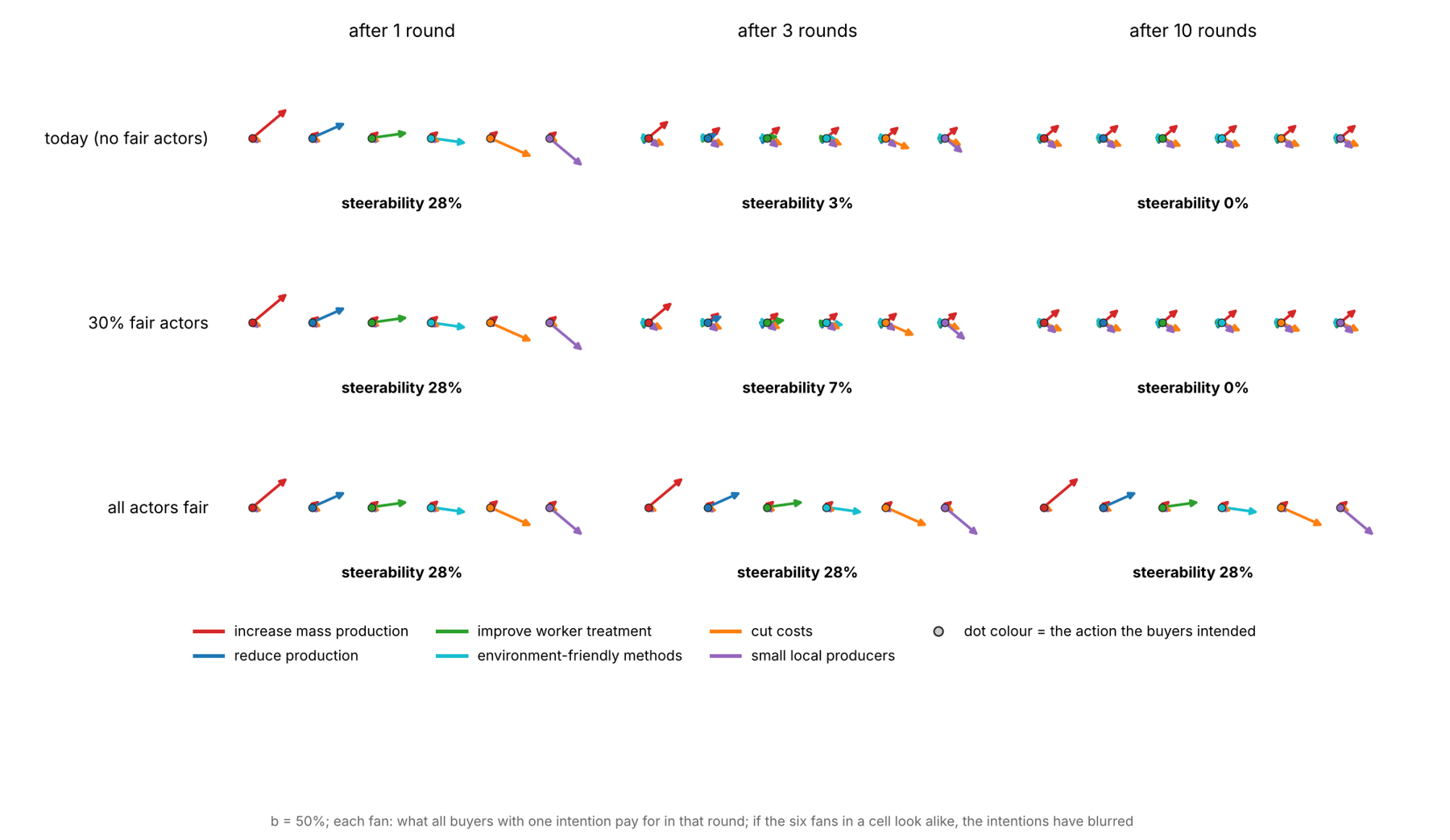
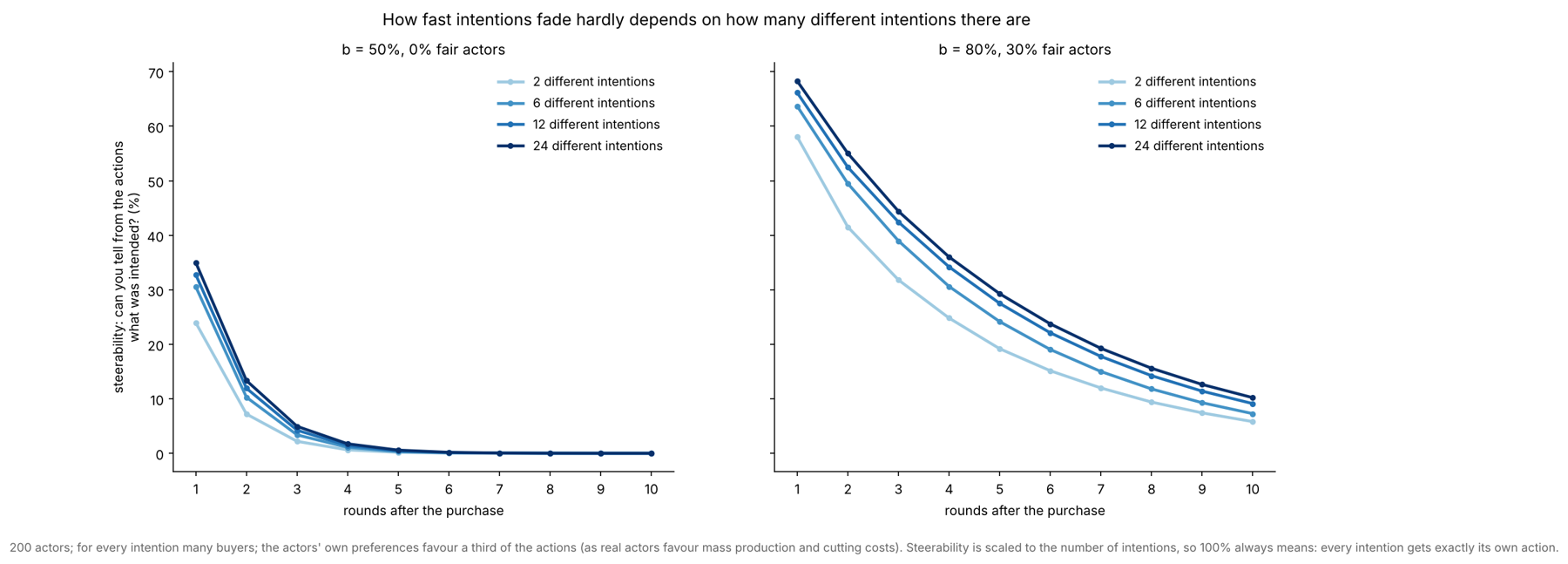
Suppose part of the money stays bound to its purpose and the rest blurs. Within a few rounds the bound part is nearly all that is left of the intention. With half the money bound, an intention falls from 28% to 3% within three rounds, and to nothing within ten. If some actors keep money bound, it fades more slowly, but it still fades. Only if every actor keeps it bound does it last.
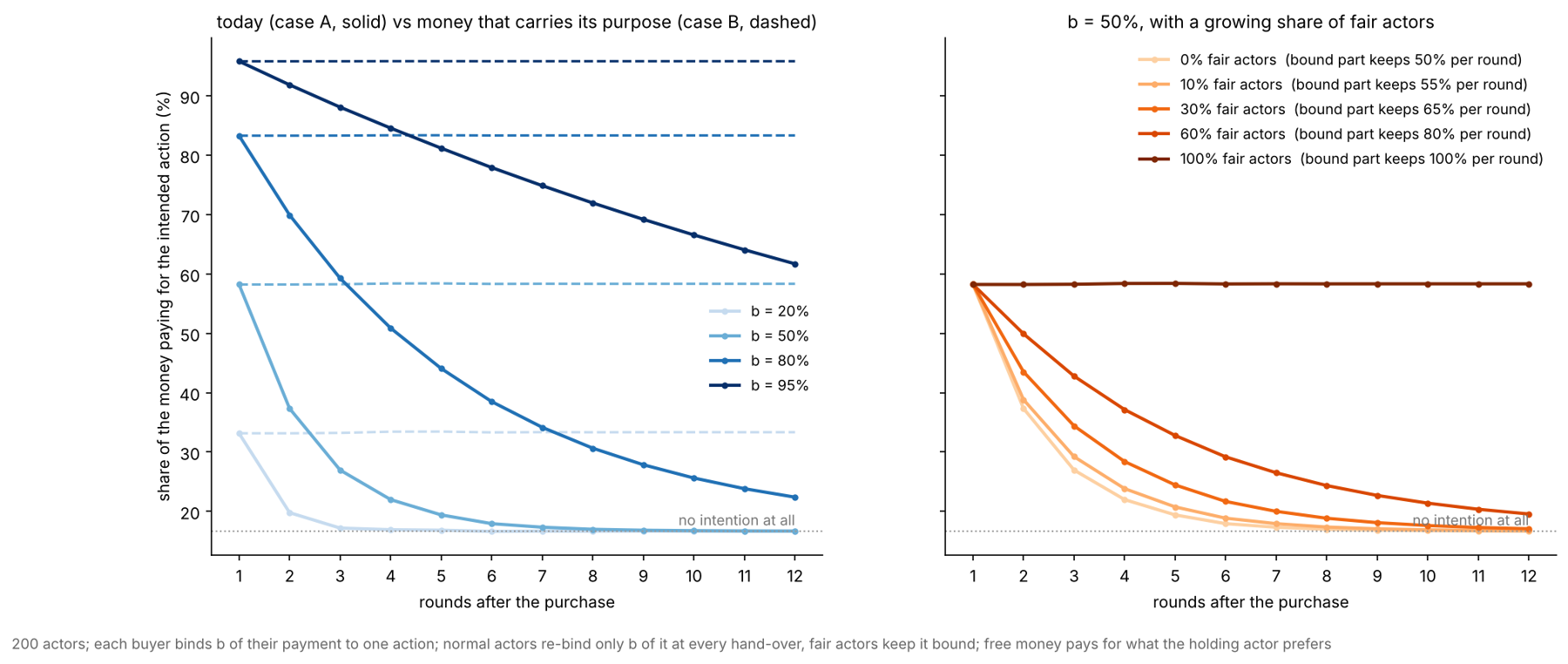
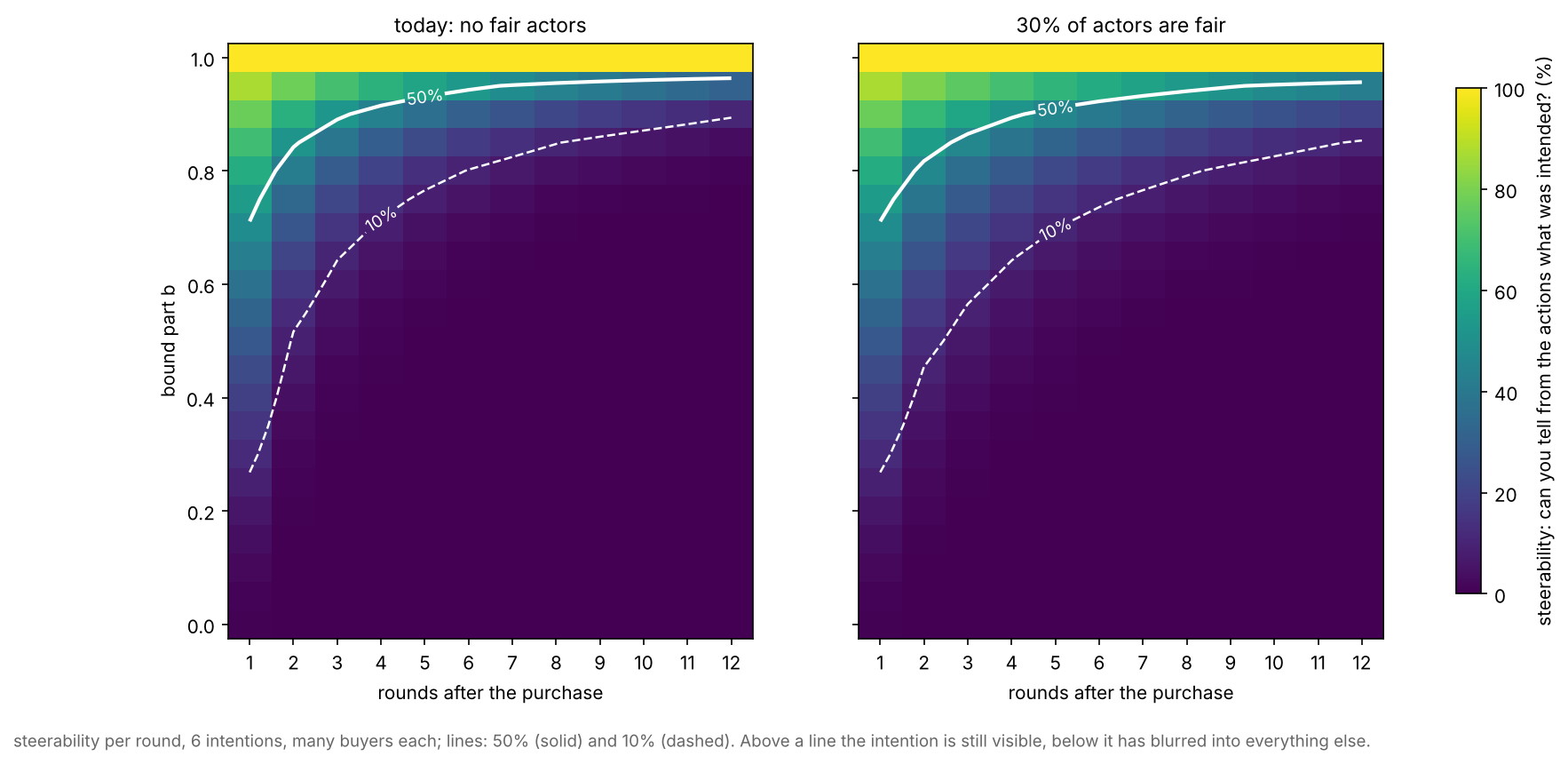
A producer can sell eco-labelled products while its spending grows mass production. The label says something about the product, not about what the money paid for it is used for next.
A pacifist buying from a local farmer still pays a share of the military. The farmer pays tax, a mechanic, an accountant, and they pay others. Part of the money reaches the action the buyer wanted least.
Illustration: shows what follows from these assumptions; not evidence.
In a small network of twelve actors, a little under one percent of the money passes through the military in every round.
A gap nobody wants
There is a large gap between what society wants and what it does. Nobody wants environmental destruction. It is a side effect of a money system that grew over history and was never designed.